Free lesson · Java Basic To Advance
Why Java Matters
A Language That Refuses to Die
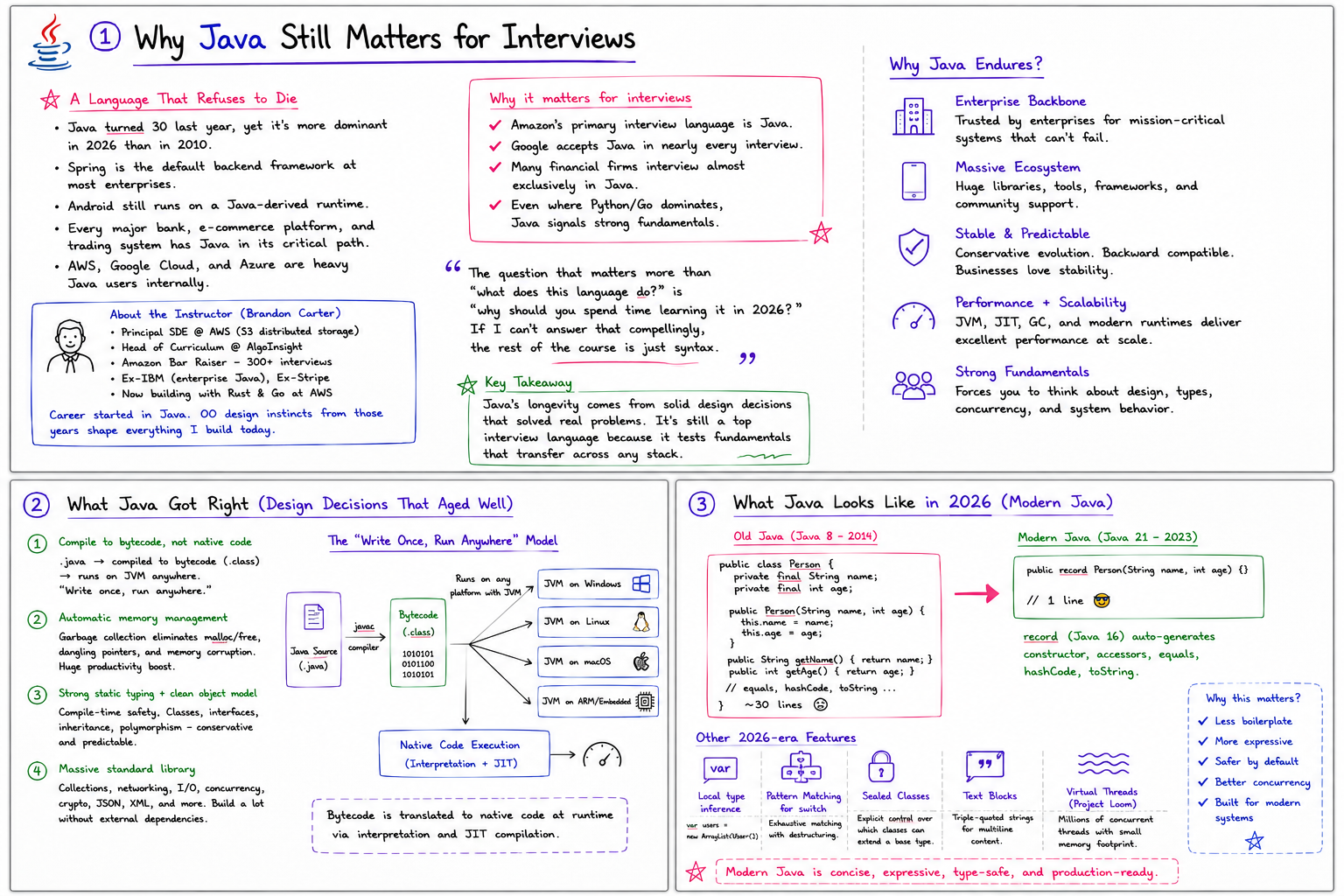
Java turned 30 last year. In a tech industry where languages routinely fade into legacy maintenance within a decade, Java is more dominant in 2026 than it was in 2010. Spring is the default backend framework at most enterprises. Android still runs on a Java-derived runtime. Every major bank, e-commerce platform, and trading system has Java in its critical path. AWS, Google Cloud, and Azure are all heavy Java users internally.
If you're preparing for FAANG interviews, Java matters more than you might think. Amazon's primary interview language is Java. Google accepts Java in nearly every interview. Many financial firms - Goldman Sachs, JPMorgan, Bloomberg - interview almost exclusively in Java. Even at companies where Python or Go dominates, Java is a respected interview language that signals fundamentals.
Hi, I'm Brandon Carter. I'm a Principal SDE at AWS, working on distributed storage at S3. I'm also the Head of Curriculum at AlgoInsight and an Amazon Bar Raiser who's conducted over 300 interviews. I spent my first 4 years out of Georgia Tech writing enterprise Java at IBM. I left Java for Stripe and now write mostly Rust and Go at Amazon - but my career started in Java, and the OO design instincts I developed during those years are what made me effective at every job since.
I'm opening this Java course because the question that matters more than "what does this language do?" is "why should you spend time learning it in 2026?" If I can't answer that compellingly, the rest of the course is just syntax.
What Java Got Right
Java was designed in the early 1990s by James Gosling at Sun Microsystems. The brief was specific: a language for "smart appliances" - TVs, toasters, set-top boxes - that needed to run on diverse hardware without recompilation. That brief produced several decisions that turned out to matter enormously, even after the original use case died.
Decision 1: Compile to bytecode, not native code. Java source compiles to bytecode that runs on the Java Virtual Machine (JVM). The same .class file runs on Windows, Linux, macOS, or anywhere else with a compatible JVM. This is "write once, run anywhere," and it eliminated an entire category of cross-platform pain that plagued C and C++ developers.
Decision 2: Automatic memory management. Java was one of the first mainstream languages with garbage collection. No more malloc and free, no more dangling pointers, no more memory corruption bugs. Productivity went up dramatically. The performance cost (which was real) became manageable as hardware improved and JVM technology matured.
Decision 3: Strong static typing with a clean object model. Java's type system catches errors at compile time that dynamic languages catch only at runtime. The object model - classes, interfaces, inheritance, polymorphism - is conservative and predictable. There are fewer ways to do things in Java than in C++, which makes code easier to read and maintain.
Decision 4: A massive standard library. Java ships with a comprehensive standard library covering collections, networking, file I/O, concurrency, cryptography, XML, JSON, and more. You can build substantial applications without external dependencies. This was a huge advantage in the pre-package-manager era and remains valuable today.
graph TD
    A[Java Source .java] -->|javac compiler| B[Bytecode .class]
    B -->|JVM on Windows| C[Native code execution]
    B -->|JVM on Linux| C
    B -->|JVM on macOS| C
    B -->|JVM on ARM/embedded| C

    style A fill:#7c3aed,color:#fff
    style B fill:#10b981,color:#fff
    style C fill:#3b82f6,color:#fff
This diagram shows Java's "write once, run anywhere" model. Java source code is compiled by javac into bytecode - a portable intermediate representation stored in .class files. That bytecode then runs on any platform that has a JVM, whether Windows, Linux, macOS, or even embedded ARM systems. The JVM translates bytecode to native code at runtime through interpretation and JIT compilation. The same .class file works everywhere a compatible JVM exists.
What Java Looks Like in 2026
Java has evolved dramatically. The Java you might remember from a college course - verbose, ceremonial, lots of boilerplate - isn't what modern Java looks like.
Here's a comparison. The same simple program in Java 8 (2014) and Java 21 (2023):
// Java 8 style
public class Person {
    private final String name;
    private final int age;

    public Person(String name, int age) {
        this.name = name;
        this.age = age;
    }

    public String getName() { return name; }
    public int getAge() { return age; }

    @Override
    public boolean equals(Object o) {
        if (this == o) return true;
        if (!(o instanceof Person)) return false;
        Person p = (Person) o;
        return age == p.age && name.equals(p.name);
    }

    @Override
    public int hashCode() {
        return Objects.hash(name, age);
    }

    @Override
    public String toString() {
        return "Person[name=" + name + ", age=" + age + "]";
    }
}
// Java 21 style
public record Person(String name, int age) {}
One line replaces thirty. The record keyword (introduced in Java 16) generates the constructor, accessors, equals, hashCode, and toString automatically. Modern Java is dramatically more concise than older versions while remaining type-safe and predictable.
Other 2026-era features that change how Java reads:
varfor local type inference -var users = new ArrayList<User>()instead ofArrayList<User> users = new ArrayList<User>()- Pattern matching for
switch- exhaustive matching with destructuring - Sealed classes - explicit control over which classes can extend a base type
- Text blocks - triple-quoted strings for multiline content
- Virtual threads - millions of concurrent threads via Project Loom
We cover each of these in detail across the course. The point right now is: modern Java is not 1998 Java. If you've avoided Java because you remember it as verbose and stuffy, the language you'd encounter today is dramatically different.
Why Java for Interviews Specifically
Three reasons Java is a strong interview language choice:
Reason 1: Type safety helps you under pressure. When you're stressed in an interview, the compiler catching your mistakes is a real benefit. A typo in a Python interview can produce confusing runtime behavior that wastes 10 minutes. The same typo in Java produces an immediate red squiggle in the IDE or a compile error you can see. Type safety is a safety net for interview pressure.
Reason 2: The standard library is interview-ready. Java's HashMap, ArrayList, PriorityQueue, Deque, and Stream API are exactly the data structures you need for coding interviews. No imports needed beyond java.util.*. Compare to languages where you might need to install or import third-party packages - Java is interview-ready out of the box.
Reason 3: It signals fundamentals. Interviewers know that writing fluent Java requires understanding generics, OO design, and JVM behavior. A candidate who's smooth in Java is signaling depth that a candidate who only knows Python or JavaScript hasn't proven. This is unfair to Python-only candidates (Python is a serious language) but it's a real bias that exists in many interview rooms.
Where Java Falls Short
A balanced view requires admitting Java's limitations.
Verbosity, even with modern features. Java still requires more characters per concept than Python or modern JavaScript. The trade-off (explicit, readable, type-safe) is worth it for most production code, but it slows you down in time-constrained interviews compared to Python.
Startup time. JVM startup takes hundreds of milliseconds. For long-running servers this doesn't matter; for command-line tools and short-lived processes, it's noticeable. Frameworks like GraalVM Native Image solve this for some use cases but add complexity.
Memory footprint. Java applications typically use more memory than equivalent Go or Rust applications. The JVM, the garbage collector, the metadata overhead - all add up. For services running at scale, this matters operationally.
The "Java is dying" perception. It isn't dying - but the perception persists in some circles, often from people who haven't looked at Java in 10 years. You'll occasionally encounter this in interviews or job searches. Knowing modern Java (records, virtual threads, pattern matching) helps you signal that you're current.
These limitations are real. None of them disqualify Java for senior engineering interviews or for production work. Every language has trade-offs; understanding Java's helps you choose it wisely.
graph LR
    A[Java strengths] --> B[Strong typing<br/>catches errors early]
    A --> C[Massive standard library]
    A --> D[Mature tooling and JVM]
    A --> E[Comprehensive concurrency]

    F[Java limitations] --> G[Verbose vs Python/Go]
    F --> H[JVM startup time]
    F --> I[Memory footprint]
    F --> J[Perception of legacy]

    style A fill:#10b981,color:#fff
    style F fill:#dc2626,color:#fff
This diagram shows Java's trade-offs honestly. The strengths include strong static typing that catches errors at compile time, a massive standard library with built-in collections and concurrency primitives, mature tooling around the JVM, and comprehensive concurrency support. The limitations include verbosity compared to Python or Go, slow JVM startup time that matters for short-lived processes, larger memory footprint than native-compiled alternatives, and a lingering perception that Java is legacy technology - a perception that doesn't match modern Java but persists in some circles.
What This Course Will Build
This course teaches Java at the depth needed for senior and staff-level interviews at FAANG companies and equivalent. It assumes you have some programming experience - not necessarily in Java - but you know what variables, functions, and loops are.
The curriculum spans 26 modules from basic syntax through engine internals to interview synthesis. The largest modules cover collections (24 Topics on the Java Collections Framework), concurrency (24 Topics on multithreading and Project Loom), and interview synthesis (the final module consolidating everything for interview preparation).
Some modules - particularly OO design (Brandon's domain), concurrency (Nikhil's domain), and memory management (Emeka's domain) - are where this course's founder voice does the most teaching work. Other modules are reference-focused: comprehensive coverage of the standard library, file I/O, networking, JDBC. Both styles are necessary for a course that's serving as both a learning resource and an interview-prep tool.
We finish with Module 26 - the interview synthesis module that mirrors the JavaScript course's Module 14: a complete interview question map, the Stuck Protocol applied to Java specifically, a 30-day prep plan, a mock interview with full annotation, and a comprehensive interview question bank.
What You Should Do Before Continuing
Three things to set up before Topic 1.2:
1. Install a recent JDK. Java 21 (the current LTS - Long Term Support release) or Java 25 (released 2025) are both fine. Download from Adoptium for free OpenJDK builds. Some readers prefer Oracle's official JDK; both work for learning.
2. Choose an IDE. IntelliJ IDEA Community Edition (free) is what most professional Java developers use. Eclipse and Visual Studio Code with Java extensions are valid alternatives. The course assumes IntelliJ in screenshots but works with any IDE.
3. Decide what success looks like. Working through this course should produce one of three outcomes: comfortable Java fluency for general programming work, focused preparation for a specific Java interview, or depth-extension for someone who already writes Java but wants to be measurably stronger. Different goals warrant different reading paths through the course - we'll guide that as we go.
Common Pitfalls
Warning: The "I already know Java" trap. Many engineers learned Java in college 10+ years ago and assume the language hasn't changed. It has, dramatically. Modern features (records, pattern matching, virtual threads, sealed classes) change how idiomatic Java reads. Treat this course as updated material even if you've used Java before.
The "Java is just Python with semicolons" trap. Java's type system, OO model, and concurrency primitives are fundamentally different from Python's. Treating Java as "Python with extra syntax" produces code that compiles but doesn't use Java well. Senior interviewers can tell.
The "I only need the syntax" trap. Senior Java interviews probe how the JVM behaves, how HashMap is implemented, how garbage collection works, why ConcurrentHashMap is faster than synchronized HashMap. Knowing syntax isn't enough. The depth Topics in this course (Modules 14, 18, 19) are where the real interview material lives.
Why This Matters in Interviews
Interview: The most common opening question in a Java interview is some variation of "tell me about Java." A junior answer covers compile-to-bytecode and JVM. A senior answer adds: the specific reasons Java's design choices matter, when Java is the right tool versus when it isn't, and a brief mention of recent language evolution (records, virtual threads, pattern matching). This signals current knowledge rather than 10-year-old knowledge.
Topic 26.12 - the interview question bank - has the full senior-candidate answer for this and dozens of other Java questions.
Try It
Exercise: Before continuing to Topic 1.2, do these three things:
- Install JDK 21 (or newer) from Adoptium
- Run
java --versionin a terminal - confirm it prints the version you installed- Open your IDE and create a new project called "java-course" - we'll use it for code samples throughout
This is just the setup. The next Topic covers Java's history in more detail, and Topic 1.7 has your first runnable Java program. By the end of Module 1, you'll have written, compiled, and run real Java code.